
Need a compressor quote? We’ve got you covered.
Fill out some basic information and then answer 9 quick questions.
A member of our sales team will reach out to you ASAP.
Compressed Air Systems

Oil-Flooded Rotary Screw Air Compressors
Ingersoll Rand’s oil-flooded rotary screw air compressors offer businesses the very best combination of time-proven designs and technologies plus new, advanced features that ensure the highest levels of reliability, efficiency, and productivity available.

Oil-Free Rotary Screw Compressors
Ingersoll Rand offers a range of high-performance, efficient oil-free air compressors for a wide range of industries & applications.



Oil-Free Scroll Air Compressor Systems
When efficiency, quiet operation, low maintenance and a small footprint are critical, Scroll Air Compressors are the smart choice. Their compact and innovative design make them ideal for many commercial applications where reliable oil-free air is required. Ingersoll Rand’s Scroll Compressors deliver more flow per kW in most cases and reach pressures up to 145 psi in a single stage of compression with no metal to metal contact anywhere - therefore the technology requires no lubrication resulting in high quality oil-free air.
Centrifugal Air Compressors
Ingersoll Rand’s centrifugal compressors incorporate the latest technology that can be used over a wide range of industries. These compressors are reliable, durable, and low maintenance.
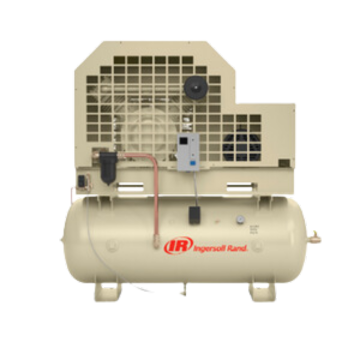
Reciprocating Air Compressors
Ingersoll Rand has designed reciprocating single stage air compressors and two stage air compressors to last a -lifetime - Thanks to quick, easy maintenance with renewable components. Easy access to the pump components in their reciprocating compressors allows for routine maintenance and replacement parts like the individually cast cylinders, the piston wear-sleeves, and the 15,000-hour bearings.
PET Compressed Air Solutions
Designed for the PET industry. Ingersoll Rand PET compressors meet the unique challenges of PET bottle blowing with advanced technologies tailored to your individual production requirements. Ingersoll Rand four-stage centrifugal and four-stage reciprocating compressors provide the critical performance you need to maximize your productivity.
Compressed Air Overview FAQ
What type of air compressor is best for an industrial facility?
The right compressor depends on how much air your facility uses, required pressure, duty cycle, air-quality requirements, and how demand changes throughout the day. Rotary screw compressors are common for continuous industrial use, while oil-free, scroll, centrifugal, and reciprocating compressors each make sense for different applications. Process & Power can evaluate the application and help size the system correctly.
What types of industrial air compressors does Process & Power offer?
Process & Power offers a broad range of compressed air equipment, including oil-flooded rotary screw compressors, oil-free rotary screw compressors, oil-free scroll compressors, centrifugal compressors, reciprocating compressors, and high-pressure PET compressed air systems.
Does Process & Power service industrial air compressors?
Yes. Process & Power provides compressed air system service, repairs, preventative maintenance, troubleshooting, installations, audits, and related support for industrial facilities. Our factory-trained and certified technicians service major lines of compressed air equipment.
Does Process & Power provide air compressor service near me?
Process & Power supports industrial customers in Memphis and Jackson, Tennessee; Little Rock and Springdale, Arkansas; Tupelo, Mississippi; and surrounding Mid-South communities. For air compressor service near me, call (901) 362-5500 with your location, equipment model, and service needs.
What is the difference between an oil-flooded and oil-free air compressor?
An oil-flooded compressor uses lubricant in its compression chamber. An oil-free design keeps oil out of that chamber, but downstream air treatment may still be needed for moisture, particles, and other contaminants. Choose the complete system around your process air-quality requirements.
How do I know if my air compressor is too small for my facility?
If pressure falls during peak production, compare measured airflow demand with compressor output at the required pressure. Check leaks, filters, piping, storage, and controls first. Continuous operation alone does not prove a compressor is undersized.
Why does my plant keep losing compressed air pressure?
Low pressure isn't always a compressor problem. Undersized piping, clogged filters, long piping runs, excessive fittings, leaks, or restrictions can create pressure drop between the compressor room and the point of use. Increasing compressor pressure may temporarily hide the problem while increasing energy consumption.
How often should an industrial air compressor be serviced?
Start with the manufacturer's schedule for the exact model, then account for operating hours, ambient conditions, and service history. Hot, humid, or dusty locations may require closer attention to cooling, drainage, and filtration.
Why is moisture getting into my compressed air system?
Compressing atmospheric air also concentrates the moisture naturally present in it. In humid areas such as Memphis, Jackson, Little Rock, Springdale, and Tupelo, moisture management can be especially important. Properly selected dryers, filters, drains, and separators help remove moisture and contaminants before they reach production equipment.
Does Process & Power offer compressed air dryers and filtration?
Yes. Process & Power offers refrigerated and desiccant compressed air dryers along with filtration for oil, water, particulates, and odors. Process & Power also supports condensate drains, air receivers, oil/water separators, system controllers, piping, and other compressed air accessories.
Can Process & Power perform a compressed air system audit?
Yes. A compressed air audit can help uncover air leaks, pressure drop, inappropriate uses of compressed air, inefficient compressor sequencing, and other problems that increase operating costs. The goal isn't simply to look at the compressor—it's to understand how the complete air system is performing.
Can compressed air leaks really increase my electric bill?
Absolutely. Even relatively small leaks become expensive when they continue around the clock. A facility with numerous leaks may be producing significantly more compressed air than production actually requires, adding unnecessary compressor runtime, energy consumption, and equipment wear.
Does Process & Power install complete compressed air systems?
Yes. Process & Power provides compressed air installation support for new facilities, expansions, and equipment replacements. Discuss equipment, piping, utility connections, startup, and ongoing maintenance so the proposal clearly defines the work included.
What should I consider before replacing an old air compressor?
Don't base the decision on horsepower alone. Actual CFM demand, operating pressure, air quality, energy consumption, production schedule, redundancy, future expansion, piping, storage, and compressor controls should all be considered. In some facilities, correcting system problems can be just as important as selecting the new compressor.
Why choose Process & Power for compressed air systems?
Process & Power provides more than compressor sales. Our team supports the complete compressed air system—from equipment selection and installation to dryers, filtration, piping, controls, preventative maintenance, repairs, audits, rentals, and system optimization. With local support across Tennessee, Arkansas, and Mississippi, we help industrial customers keep compressed air reliable, efficient, and ready for production.
What information do I need for a compressor quote?
Have your required airflow and pressure, operating schedule, electrical supply, air-quality needs, and facility location ready. Photos and details of existing equipment help Process & Power review the application. Call (901) 362-5500 to get started.