
MasoSine Sinusoidal Process Pumps
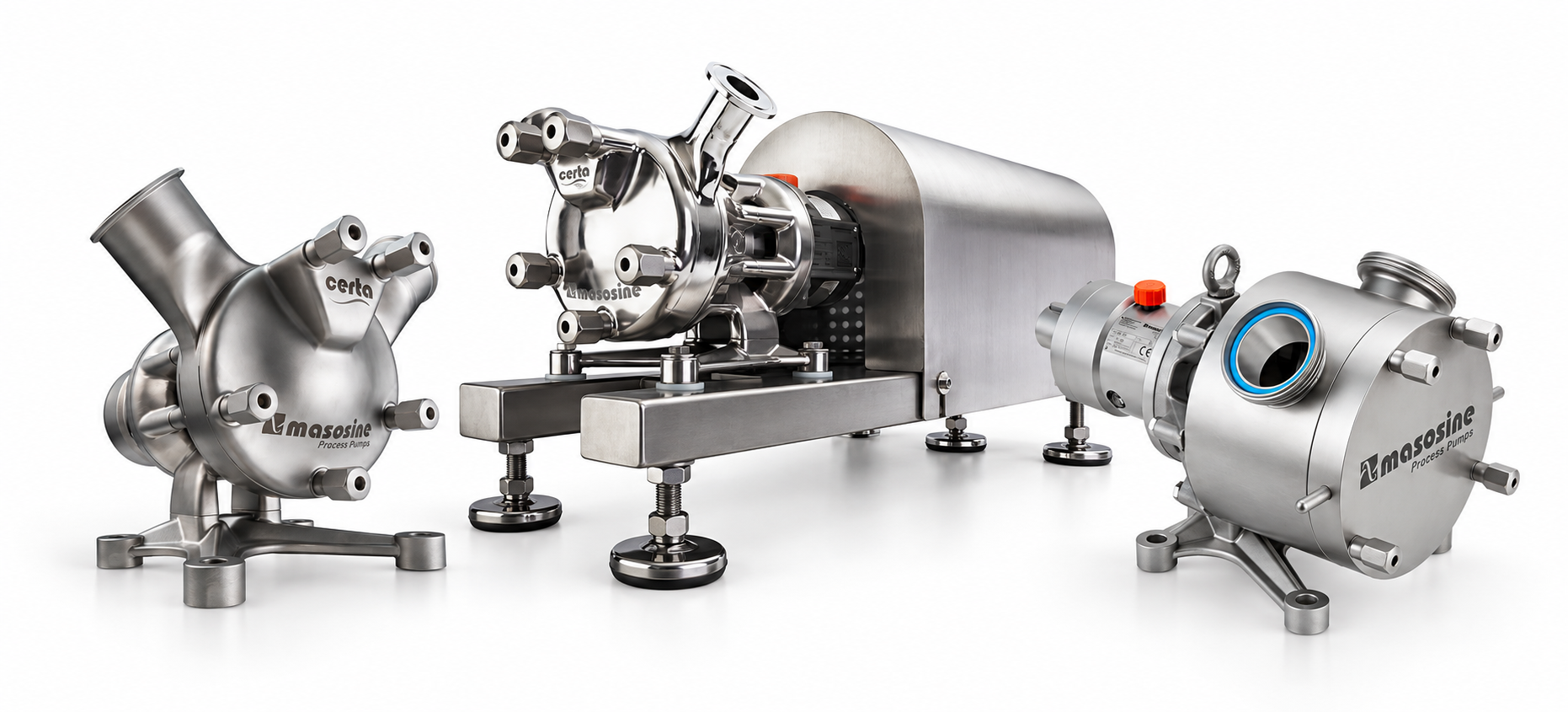
At Process & Power, we offer MasoSine sinusoidal process pumps for the gentle and efficient transfer of viscous, shear-sensitive and solids-containing products.
MasoSine pumps use a sinusoidal rotor to create smooth, low-pulsation flow. Their gentle pumping action helps preserve product texture, appearance and consistency while providing the suction needed to transfer difficult high-viscosity materials.
How MasoSine Pumps Work
A single sinusoidal rotor creates four evenly sized chambers inside the pump. As the rotor turns, each chamber opens at the inlet, carries the product through the pump and contracts at the discharge.
A gate separates the inlet and outlet sides of the pump. This operating principle produces smooth flow with very little pulsation and fewer product-damaging forces than many conventional positive-displacement pump designs.
Certa and Certa Compact Process Pumps
MasoSine Certa pumps are designed for hygienic food, beverage and process applications. They combine low-shear product handling with strong suction, efficient viscous-fluid transfer and a cleanable pump design.
Certa pumps can handle products such as:
Dairy products and cheese curds
Sauces, soups and dressings
Bakery fillings and dough-related mixtures
Fruit concentrates
Meat and poultry products
Brewing ingredients and yeast
Personal-care products
Other viscous or shear-sensitive materials
The Certa range includes several sizes for different flow, pressure and particle-handling requirements. Certa Compact configurations provide the same sinusoidal pumping principle where installation space is limited.
Certa Plus Process Pumps
Certa Plus pumps are designed for pharmaceutical and biotechnology processes that require high-purity materials, cleanability and gentle product handling.
The Certa Plus design provides low-shear, essentially pulse-free transfer along with a self-draining wet end. Available certifications and material options support hygienic and aseptic process requirements.
SPS Process Pumps
MasoSine SPS pumps are designed for industrial transfer applications involving viscous, sensitive or solids-containing materials. The SPS range combines powerful suction with low-shear pumping and can handle products across a wide viscosity range.
Its simple wet-end design allows routine maintenance to be completed in place without removing the entire pump from the process line.
Why Choose MasoSine Pumps?
Gentle, low-shear product transfer
Smooth flow with minimal pulsation
Strong suction performance
Efficient handling of viscous fluids
Ability to pass soft solids
Helps reduce product damage and waste
Reversible pumping direction
Separation between wet and dry ends
In-place maintenance
Hygienic and aseptic options
Energy-efficient operation in many viscous-product applications
Multiple port orientations and connection options
Contact Process & Power for MasoSine Pumps
Process & Power can help select a MasoSine process pump based on your required flow, pressure, viscosity, particle size, suction conditions, temperature, cleanability and product-handling requirements.
Located at: 1721 Corporate Avenue • Memphis, TN 38132
Call us at: (901) 362-5500
MasoSine Sinusoidal Process Pumps FAQ
How does a MasoSine pump work?
A sinusoidal rotor forms moving chambers that carry product through the pump. The design is intended for smooth transfer with low shear.
What MasoSine ranges are featured?
The page includes Certa, Certa Compact, Certa Plus, and SPS. Their intended applications and available configurations differ, so selection should follow the process requirements.
What is Certa Plus intended for?
The page presents Certa Plus for high-purity pharmaceutical and biotechnology applications. Confirm the exact material, cleaning, and documentation requirements for the proposed configuration.
When is Certa Compact worth considering?
It offers the sinusoidal pumping approach in a compact arrangement. Check the required duty and service access as well as the available installation space.
Can MasoSine pumps transfer soft solids?
Suitable models can handle products containing particles. Provide particle size, concentration, and acceptable damage so the pump and operating speed can be evaluated.
Does low pulsation mean every installation has perfectly constant flow?
No. Actual delivery also depends on speed, inlet supply, fluid behavior, and connected piping. Define the process's acceptable flow variation when selecting equipment.
How do I select a pump for a sensitive product?
Provide viscosity, particle characteristics, temperature, flow, pressure, and acceptable product changes. Pump speed and inlet conditions matter alongside the pumping principle.
Does stainless steel construction automatically make a pump hygienic?
No. Surface finish, seals, drainability, cleanability, and installation details also matter. Confirm the documentation and cleaning requirements for the exact configuration.
Can this pump be cleaned in place?
That depends on the model and installation. Confirm required cleaning flow, temperature, chemistry, and valve arrangements, then validate the cleaning procedure for the process.
Can one pump handle both product and cleaning cycles?
Possibly, but both duties must be checked. Product viscosity and cleaning-liquid flow can require different speeds, pressures, and operating limits.
What can cause product leakage around a seal?
Wear, incompatible elastomers, dry running, unsuitable seal support, or shaft movement may contribute. Investigate repeated failures instead of replacing the seal without reviewing conditions.
Why is product texture changing during transfer?
Excessive speed, restrictions, temperature changes, recirculation, or poor inlet conditions may affect the product. Compare samples and operating data before deciding which adjustment is needed.
What maintenance should hygienic pumps receive?
Follow the model's inspection schedule for seals, product-contact parts, bearings, and clearances. Include cleaning verification and checks for surfaces or components that could retain product.
Can a hygienic pump be rebuilt?
Evaluate mechanical condition and the ability to restore the required product-contact finish and clearances. Confirm replacement-part traceability and revalidate cleaning where the repair affects the process.
How can I get local support for MasoSine Sinusoidal Process Pumps?
Contact Process & Power at (901) 362-5500 with your location, equipment identification, and application or service concern. The team can review selection, parts, and service options for your needs.
What should I send when requesting a quote?
Include the required duty, fluid or process details, operating conditions, utilities, and installation dimensions. For existing equipment, add nameplate photos, model and serial numbers, and a description of the problem or planned change.